
Menstrual Cycle (reproductive years)
The menstrual cycle is essentially a monthly hormonal choreography.
This diagram shows how hormone levels rise and fall across a typical 28-day cycle.
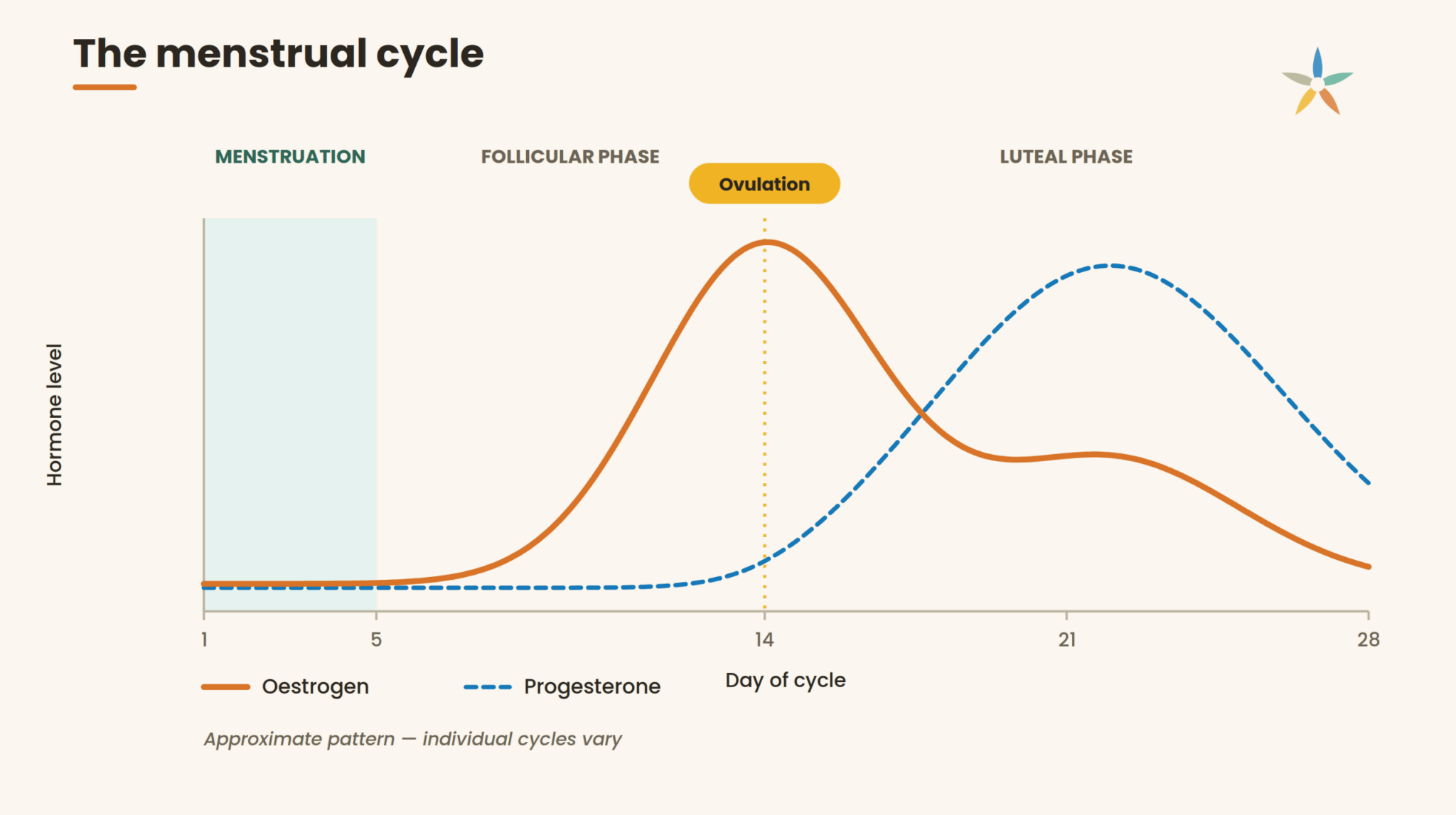
Days 1-5 (Menstruation – your period): Both oestrogen and progesterone are at their lowest. This drop is what causes the lining of the uterus (womb) to shed – this is your period.
Days 5-14 (Follicular phase): Oestrogen increases steadily as an egg develops in the ovary. It rebuilds the lining of your uterus (womb), preparing it for a possible pregnancy.
Around day 14 (Ovulation): Oestrogen peaks sharply just before ovulation, triggering the release of an egg.
Days 15-28 (Luteal phase): Progesterone now takes the lead, rising significantly to prepare the lining of the uterus (womb) for a fertilised egg. If no pregnancy occurs, both hormones drop – and the cycle begins again.
In general, this rhythm repeats, month after month, from puberty through to the lead-up to perimenopause.
What happens during perimenopause and menopause?
As you already know, perimenopause is the time before menopause.
It is the period or phase of change – typically lasting four to eight years – during which the ovaries gradually begin to produce less oestrogen and progesterone.
What is important to remember is that during this time our oestrogen and progesterone levels do not decline in a smooth, steady way.
Instead, levels swing in unpredictable or erratic ways – sometimes surging too high, sometimes dropping too low – before eventually settling at a consistently lower level.
Oestrogen and progesterone levels are unstable and unpredictable during perimenopause – and this is what drives most of the symptoms women experience during this time.
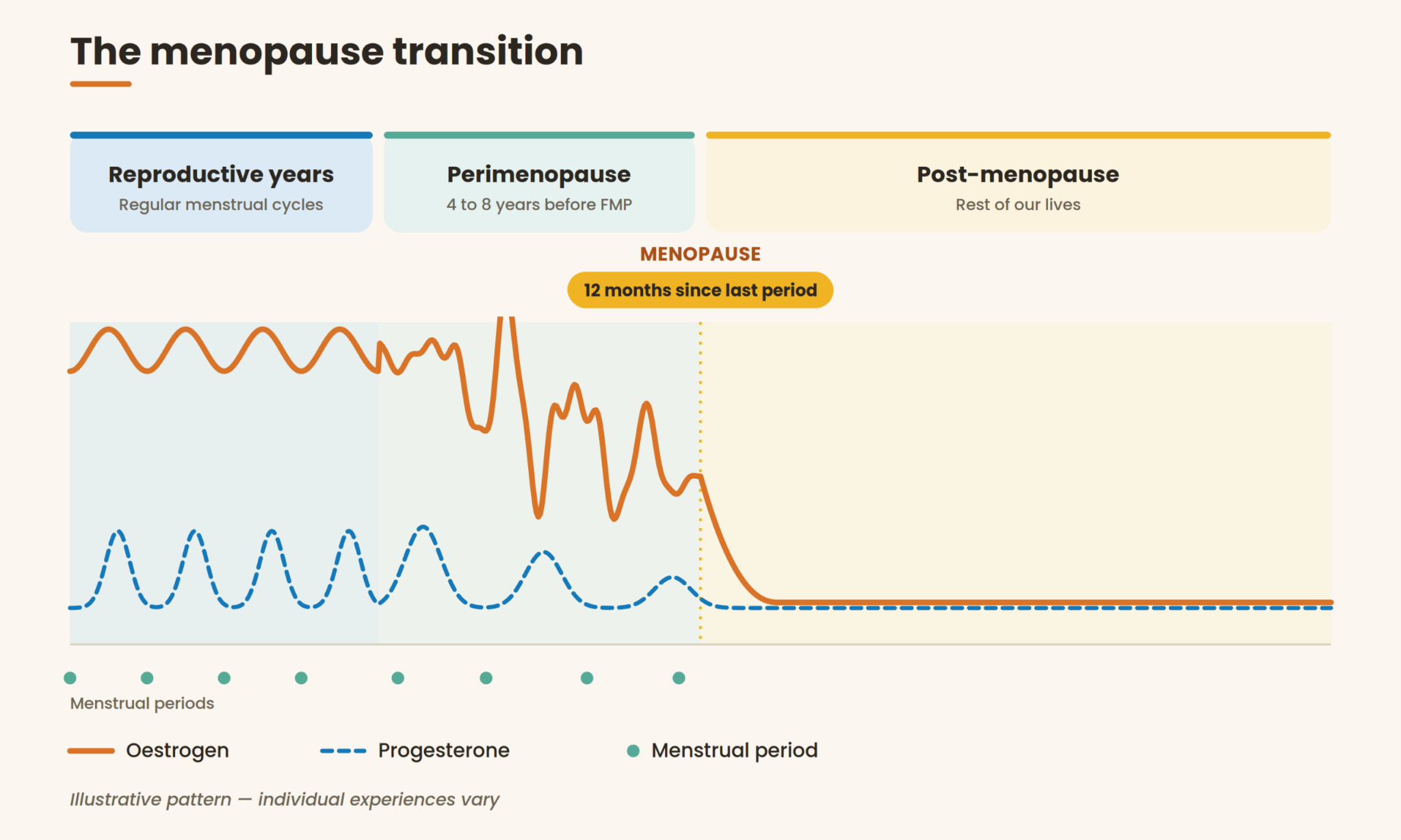
The diagram above illustrates or shows this: the erratic lines in the perimenopause phase are very different to the more regular rhythm of the reproductive years.
When ovulation does not occur, progesterone is not produced to regulate the lining of the uterus (womb). Oestrogen continues to stimulate the lining to thicken, without progesterone to check this.
When the lining of the uterus eventually sheds, the result can be a much heavier flow than usual. Heavy periods may include large clots, or bleeding that soaks through protection quickly. Many women may experience heavier period flow during early perimenopause.
After menopause, the ovaries produce very little oestrogen or progesterone.
This is a permanent change, and the body gradually adapts.
However, the effects of low hormone levels continue – and for some women, symptoms persist for many years, if left untreated.
My Menopause SA
Evidence-based menopause information for South African women.
Page last reviewed: 1 March 2026
Next review due: 1 March 2027